
- EMPOWER
- AUTOMATE
- PROTECT
In-house IT vs managed IT: an honest comparison for growing businesses
A detailed comparison of in-house IT vs managed IT models to help growing businesses determine the most cost-effective and secure way to support their operations.
Cyber6 Team · · Last reviewed · 6 min read
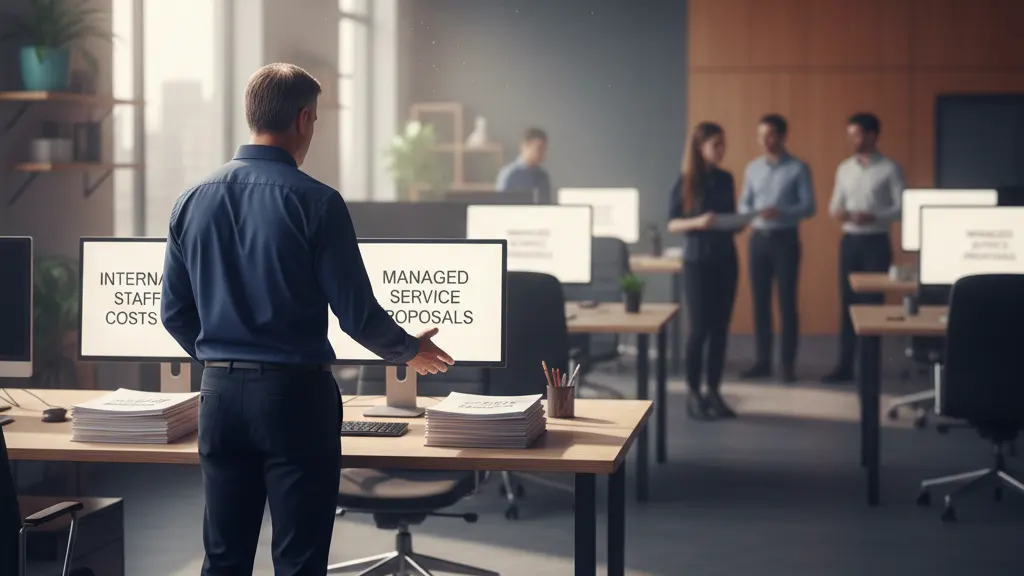
The dilemma of in-house IT vs managed IT
As a business grows, its technology needs become more complex. What started as a few laptops and a basic Wi-Fi router quickly turns into a network of servers, cloud applications, and sensitive customer data. At this stage, many business owners face a critical decision: should they hire an internal IT person or partner with a managed service provider? The choice between in-house IT vs managed IT is not just about cost; it is about how you want to manage risk, expertise, and scalability.
An internal IT employee offers a sense of control and immediate availability. They sit in your office, they know your team, and they are there to fix a printer issue the moment it happens. However, relying on a single person also creates a significant point of failure. If that person is sick, on vacation, or decides to leave the company, your technology support disappears with them. Managed IT, on the other hand, provides a team-based approach that ensures consistent support regardless of individual staff changes. In this comparison, we will look at the pros and cons of both models to help you decide which is right for your business.
The advantages of the managed IT model
Managed IT services provide several distinct advantages for growing businesses, particularly those that need to scale quickly without adding significant overhead. One of the biggest benefits is the breadth of expertise you gain access to. A single IT person cannot be an expert in everything—security, networking, cloud architecture, and help desk support are all deep specialties. When you partner with an MSP, you get a whole team of experts who each specialize in different areas.
- Predictable Monthly Costs: You pay a set fee that is easier to budget than salaries, benefits, and training for internal staff.
- 24/7 Monitoring and Support: MSPs use automated tools to watch your systems around the clock, something an individual employee cannot do.
- Scalability: It is much easier for an MSP to add support for new employees or new offices than it is to hire and train new internal staff.
- Advanced Security Tools: MSPs invest in high-end security software and share the cost across many clients, giving you access to better protection.
- Strategic Planning: Good MSPs provide vCIO services to help you plan your technology roadmap for the next three to five years.
The benefits of having in-house IT staff
Despite the advantages of managed services, there are still compelling reasons to consider in-house IT staff, especially for larger organizations or those with highly specialized needs. The most obvious benefit is physical presence. If a piece of hardware fails or a network cable is unplugged, an internal staff member can be there in seconds. They are also deeply integrated into your company culture and have a level of business context that an outside partner might take longer to develop.
- Immediate Physical Response: Ideal for offices with complex physical infrastructure or high-frequency hardware issues.
- Deep Business Integration: They understand the unique workflows and personalities of your team perfectly.
- Total Control Over Priorities: You can direct their time to any task at any moment without worrying about a service contract.
- Specialized Knowledge: If you use highly custom software, an internal person can spend 100% of their time mastering it.
However, these benefits come with higher costs. Beyond just salary, you must pay for benefits, taxes, office space, and continuous training to keep their skills current. You also face the risk of 'knowledge silos,' where one person holds all the keys to your network, making the business vulnerable if they leave. This is why many companies that hire internal IT staff still use an MSP for overflow support or high-level security management.
Cost comparison: The hidden figures
When comparing the cost of in-house IT vs managed IT, it is important to look at the total cost of ownership. For a single internal IT person with a salary of 0,000, the actual cost to the business is often closer to 0,000 or 00,000 after accounting for benefits, taxes, and overhead. You also have to consider the cost of the tools they need—monitoring software, security suites, and ticketing systems—which can add thousands more to the annual budget.
A managed service provider typically charges based on the number of users or devices. For a business with 30 employees, the annual cost of a high-quality MSP might be 5,000 to 0,000. This is significantly less than a single full-time hire, yet it provides a whole team of specialists and all the necessary management tools. This efficiency is why the managed model is the standard for small and mid-sized businesses.
- Calculate the full cost of an internal hire, including salary, benefits, and taxes.
- Add the cost of management tools and security software licenses.
- Compare this to a quote from a managed service provider for your current headcount.
- Factor in the value of 24/7 monitoring and access to multiple specialists.
- Consider the risk and cost of downtime if an internal staff member is unavailable.
The hybrid model: The best of both worlds
For many growing businesses, the choice between in-house IT vs managed IT is not all-or-nothing. A hybrid model is increasingly popular. In this scenario, the business hires one internal IT manager who focuses on strategy, project management, and daily user support. They then partner with an MSP to handle the heavy lifting: 24/7 monitoring, security management, backups, and after-hours support.
This approach allows the internal IT person to focus on high-value business initiatives rather than getting bogged down in routine maintenance and security patches. It also provides the business with a safety net; if the internal manager leaves, the MSP is already familiar with the network and can keep things running smoothly during the transition. The hybrid model offers the local presence of internal staff with the deep expertise and reliability of a managed provider.
Which model is right for your business?
Deciding between in-house IT vs managed IT depends on your specific situation. If you are a small business with fewer than 50 employees, a managed service provider is almost always the most cost-effective and secure choice. If you have over 100 employees and very complex internal workflows, you might benefit from starting to build an internal team while keeping an MSP for specialized support.
Ultimately, the goal is to have a technology environment that is stable, secure, and supportive of your business goals. Whether you choose an internal hire, a managed partner, or a combination of both, the key is to ensure that your IT strategy is proactive and aligned with where your company is headed.
What to do next
- 01Audit your current IT workload and identify how many hours are spent on routine maintenance.
- 02Get a quote for managed services to compare against your current or planned internal IT costs.
- 03Evaluate your current risk levels, particularly around security and data backups.